Ask most boys between five and ten what they’d build if they could have anything in their room, and a tank comes up more often than parents expect. Not a poster of one, not a toy version on a shelf — an actual tank, big enough to climb into, with a hatch, a gun barrel, and somewhere to sleep. This bed lineup is built around exactly that request. From the outside it reads as an armored vehicle down to the last rivet. Once a boy climbs through the hatch, the whole thing switches over to a padded, quilted bunk with a dashboard bolted to the front wall. It’s worth going part by part to see how a design this specific actually holds together as a bed.
Why a Tank Shape Works So Well in a Boy’s Room
Most bedroom furniture is built around a rectangle — a bed frame, a dresser, a desk. A tank breaks that pattern completely, and that’s a big part of why it holds a kid’s attention longer than a themed bedspread or a wall decal would. The shape itself invites a story before anyone even sits down: there’s a barrel to aim, a turret to climb around, and a hatch that has to be opened to get inside. None of that requires a parent to set anything up or hand a kid a toy to start playing — the bed does that work on its own, every single day, just by sitting there in tank form.
There’s also a practical side to picking a shape this bold for a boy’s room. A themed bed like this tends to anchor the whole space, which means the rest of the room can stay fairly simple — plain walls, a rug, a window — without the room feeling unfinished. The tank supplies enough visual weight on its own that it doesn’t need a matching wallpaper or a coordinated ceiling fan to look complete.
Reading the Hull: A Feature-by-Feature Look
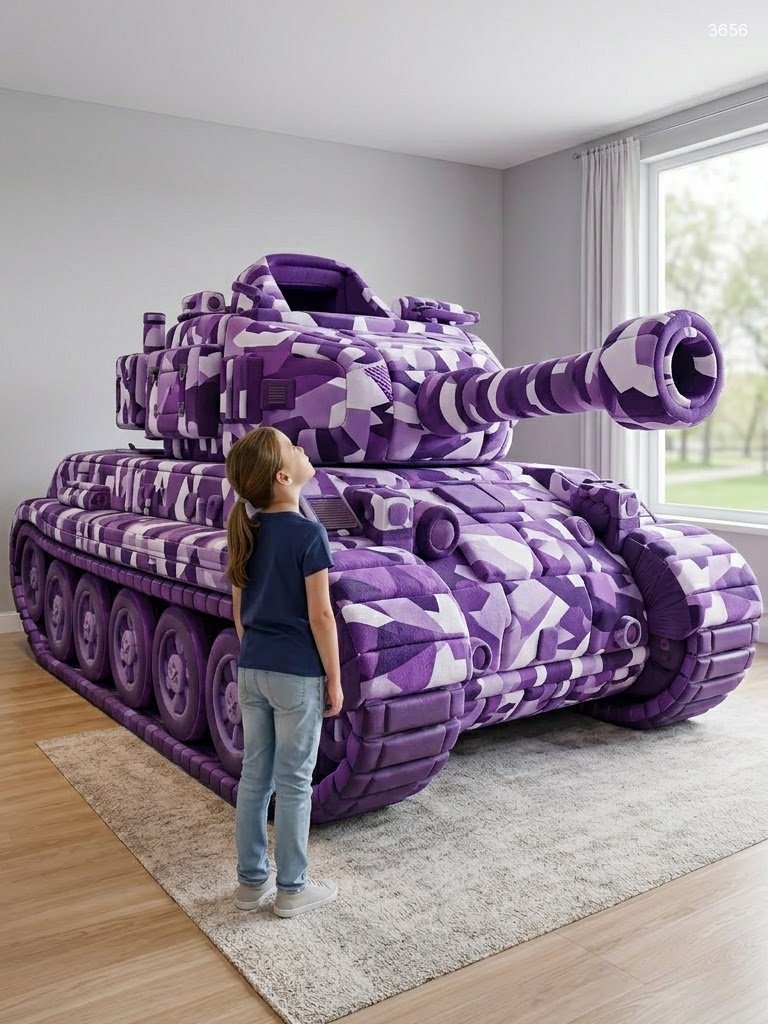
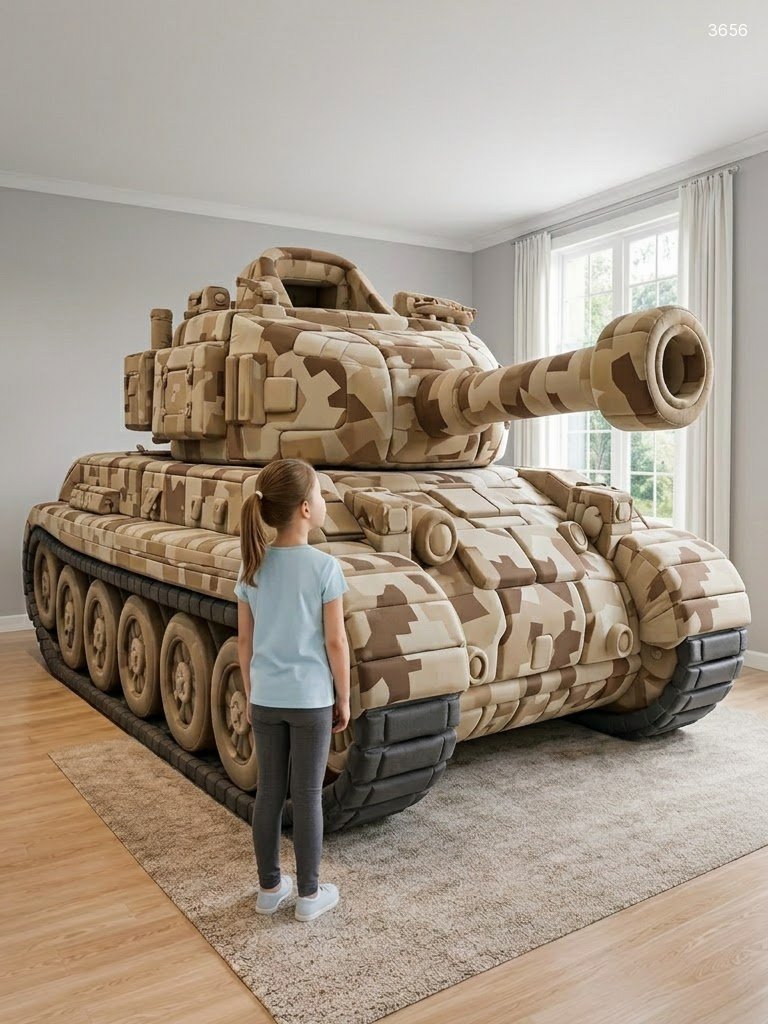
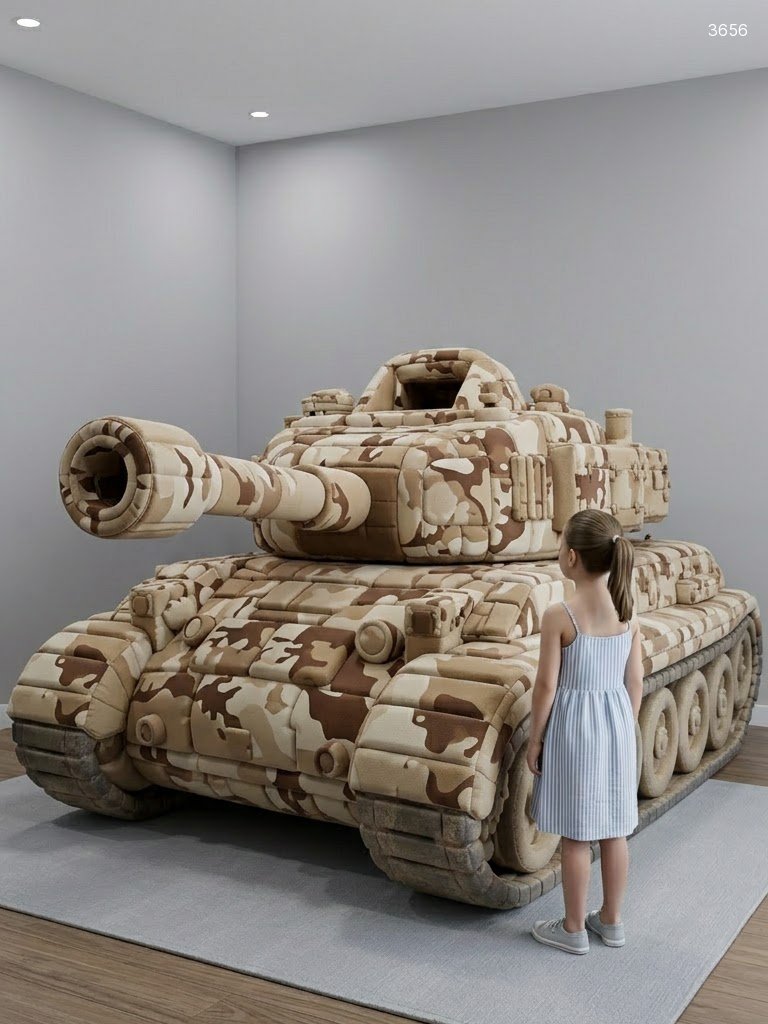
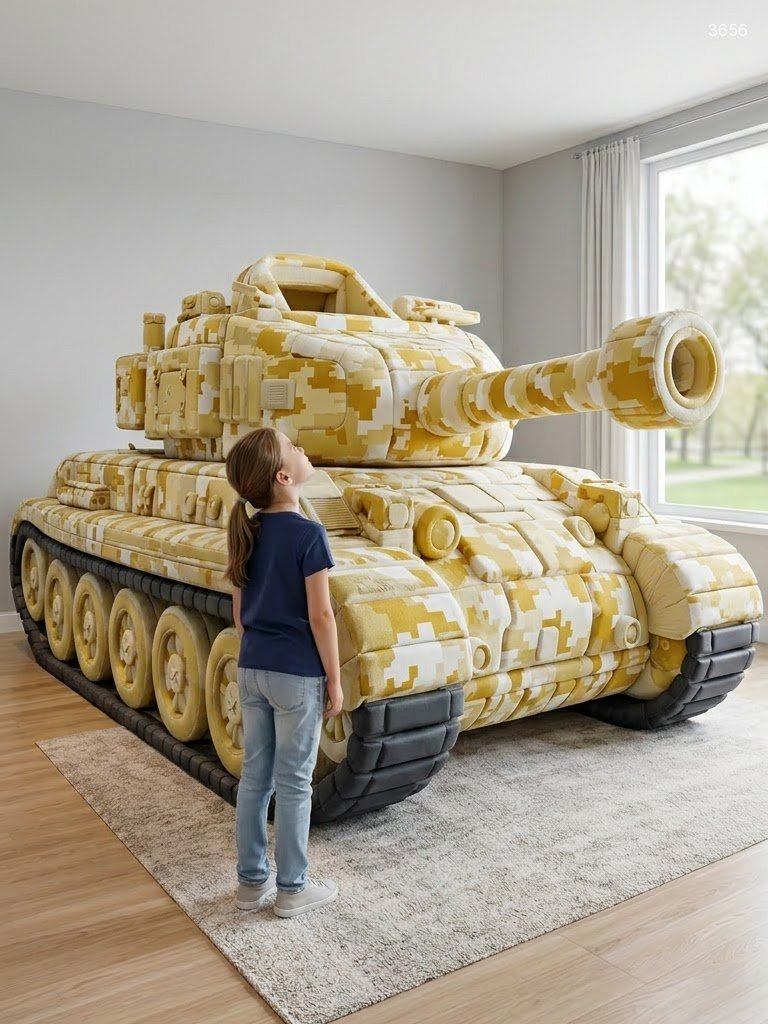
Spend a minute walking around the outside and the level of detail becomes obvious. The track assembly runs the full length of the hull, link by link, wrapped around road wheels that are individually shaped rather than molded as one flat strip. Side skirts hang along the hull above the tracks, exactly where they’d sit on a real armored vehicle, and small raised boxes and hatch covers break up the flat panels the way stowage bins and access plates would on the real thing.
Up top, the turret sits slightly offset with a raised commander’s hatch and a periscope housing, and the main gun extends out from the turret face with a widened muzzle brake at the very end — not a tapered stub, but a full-length barrel that reads as the dominant feature of the whole silhouette from across a room. Every one of these details is carved into the foam surface itself, so shadows fall across the panel lines and rivet heads the same way they would on a real hull, which is a big part of why the tank looks convincing in a photograph and not just up close.
Four Camouflage Finishes, Four Different Missions
The same hull comes finished in a handful of different camo schemes, and each one changes the personality of the build without changing a single structural element underneath.
The arctic scheme leans on cold steel blues and ash greys, broken up with white blotches — a finish that suits a boy who gravitates toward snow, ice, and cold-weather settings in whatever he’s currently reading or watching. The desert scheme flips that entirely, going tan, sand, and coffee brown, closer to a vehicle built for open, dry terrain than a combat front. The deep crimson build takes the boldest approach of the group, wrapping the whole hull in dark red with grey-white accents, which reads more like a command vehicle than a stealth one. A fourth option swaps soft blotches for a sharp red-and-white digital pixel pattern, giving the same hull a much more graphic, modern look than the traditional blotch camo used elsewhere.
None of these changes what’s happening structurally — the hatch, the bunk, and the dashboard sit in the same place across every finish. The choice really comes down to which color story fits a particular kid’s taste, or which one matches the rest of the room.
Through the Hatch: First Look at the Crew Cabin
Climbing through the side opening is where the whole design flips. Outside, everything is armor plating and sharp panel lines. Inside, the walls and ceiling are wrapped floor to roof in diamond-quilted padding, stitched in a cross-hatch pattern that carries the same camo tones as the hull. There isn’t a hard corner anywhere within a boy’s reach — the padding curves continuously from the side walls up into the ceiling, closer to the lining of a padded travel case than to the inside of a vehicle.
Two round portholes sit in the side walls, each ringed in soft padding with a clear pane set into the center, and a third opening cuts into the ceiling as a skylight, letting daylight fall straight down into the cabin. Between the three openings, the interior stays bright and open rather than closed off, even with padded walls on every side.
Where the Actual Sleeping Happens
The bunk runs along the back wall as a wide cushioned pad, thick enough to work as a real mattress rather than a thin bench cover, with a raised edge along the open side that keeps a blanket or pillow from sliding off in the night. A boy can stretch out fully across it with room to spare, and because the padding on the bunk matches the padding on the walls, there’s no hard seam anywhere near where a shoulder or a head would land during the night.
A narrow ledge runs beside the bunk in some builds — just enough space to set down a flashlight, a book, or whatever stuffed animal is currently assigned to guard duty. It’s a small addition, but it’s the kind of detail that keeps the bunk from feeling like an afterthought tacked onto a display piece.
Behind the Controls: Dashboard, Joysticks, and Screens
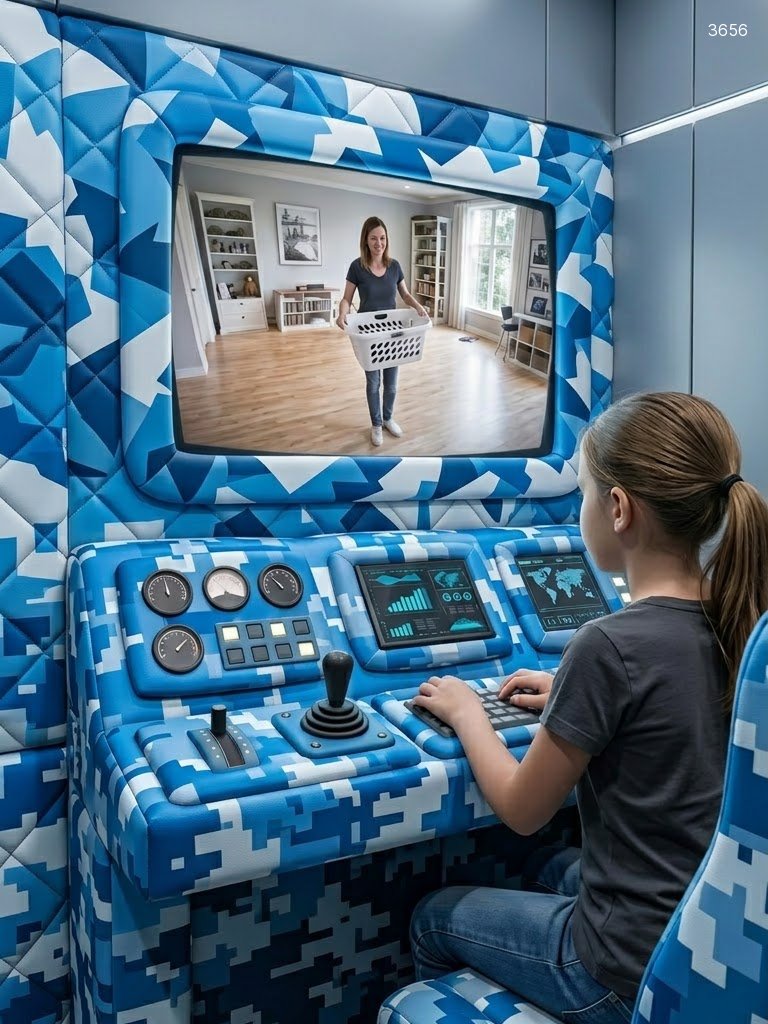
Every build includes a driver’s station built into the front corner, with a padded dash holding a cluster of round gauges, toggle switches, twin joysticks, and a small keyboard, all molded in foam and finished to match the surrounding camo. Two side displays run glowing readouts — bar graphs, waveforms, a radar-style sweep — giving the impression of a vehicle actively powered up rather than a static prop sitting in the corner.
A larger screen sits above the dash, framed the same way as the rest of the cabin. In one build, that screen shows a mom standing in an empty room holding a laundry basket — a small joke built right into the design, since apparently not even a tank commander is out of reach when it’s time to help around the house. It’s a detail that gives the console a bit of personality beyond just switches and dials, and it’s the kind of thing a kid notices and brings up again days later.
Touch Test: What the Fabric Actually Feels Like
Running a hand across any panel shows a brushed, fleece-like finish rather than a stiff upholstery weave. On the blue-grey build, individual fibers catch the light along each blotch edge, giving the pattern real texture instead of a flat printed look. The tan and brown desert version has the same brushed surface, just shifted into warmer, sandier tones that fade from cream through to a deep coffee brown across a single panel.
Underneath that surface, the foam itself has enough density to hold its shape as a wall or ceiling panel while still giving slightly under a hand or a shoulder. That balance matters — foam that’s too soft would sag out of its molded shape over time, and foam that’s too firm would defeat the whole purpose of a padded cabin. The panels here sit right in the middle of that range.
Fitting a Tank Into an Ordinary Bedroom
Every scene showing the finished build is staged in a completely normal home — laminate flooring, plain walls, a window with sheer curtains, an area rug underfoot. That matters because it shows this isn’t furniture designed for a converted garage or a dedicated playroom; it’s sized to take over a bedroom corner the same way a bunk bed or a loft frame would, replacing the existing bed rather than sitting next to it. Once it’s in place, the tank does triple duty as the bed, the reading nook, and the fort, all inside one footprint.
The side hatch sits at a height a young boy can climb through on his own, without needing a boost every time he wants in or out, which matters for a piece of furniture he’s going to use multiple times a day.
Folding It Down When It’s Time to Move
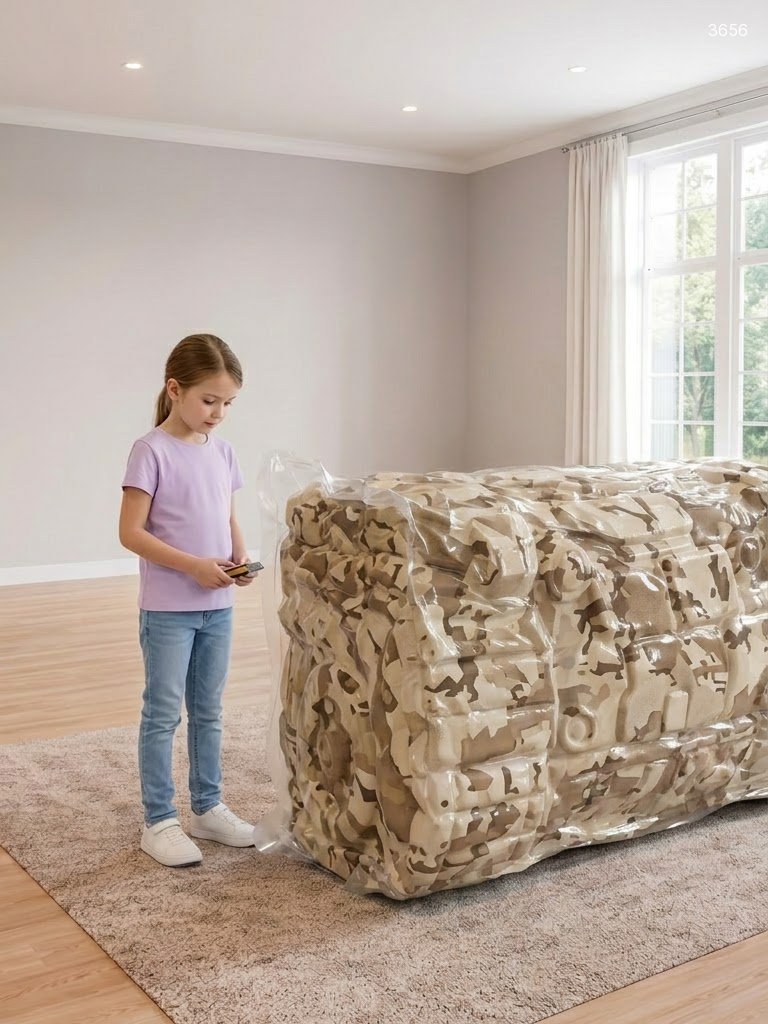
One of the more surprising details in this lineup is how the whole structure comes back down to size. A finished tank, fully built up, towers well above a standing adult — but the same build compresses into a soft-sided, vacuum-sealed bag flat enough for a boy to stand next to while holding a remote control. That flat-fold step is what keeps a build this large practical for a normal household, since it can come apart for storage or a move and then expand back into the same tank shape once it’s unpacked again.
A Few Safety Basics Worth Knowing
- Every wall, ceiling panel, and corner inside the cabin is padded foam, not a hard surface, including the area around the two portholes.
- The dashboard’s knobs, switches, and joysticks are molded from the same soft foam as the rest of the interior, so they’re built for tactile play rather than as functioning mechanical parts.
- The portholes and roof skylight keep light and airflow reaching the bunk inside an otherwise enclosed space.
- As with any padded, enclosed sleeping nook, a parent should do the same basic check they’d run on a canopy bed or a loft bed — bedding, ventilation, and a clear path in and out of the hatch.
Why This Keeps a Boy’s Attention Longer Than a Typical Bed
A lot of themed kids’ furniture works for a few weeks and then fades into the background once the novelty wears off. A tank-shaped bed tends to hold up better because it isn’t just decoration — there’s a console to sit at during the day, a hatch to climb through, windows to look out of, and a bunk that only shows up once the “mission” for the day is done. That daytime-to-nighttime split gives the piece two separate jobs instead of one, which is a big part of why it keeps getting used well past the first week.
The enclosed cabin shape also gives a boy a defined space that’s fully his own — walls on every side, a hatch he controls, and a console that only he operates. For a lot of kids that sense of a contained, private space is calming in a way an open bed frame never quite manages, especially once bedtime becomes just another part of the daily routine inside the tank rather than a separate event.
Closing Thoughts on the Build
From across the room, this reads as an armored vehicle scaled to fill a bedroom corner, gun barrel and all. Climb through the hatch and it turns into a padded, window-lit cabin with a bunk along the back wall and a working dashboard up front. The camo finishes give the same hull four different personalities, but the layout underneath — hatch, cabin, bunk, console — stays the same across every version, sized to work in a real bedroom and foldable enough to pack away when it’s time to move. For a boy who wants his bed to double as a fort, a cockpit, and a hideout, that combination is easier to appreciate after actually walking through the hatch than it ever comes across in a photo of the hull alone.